
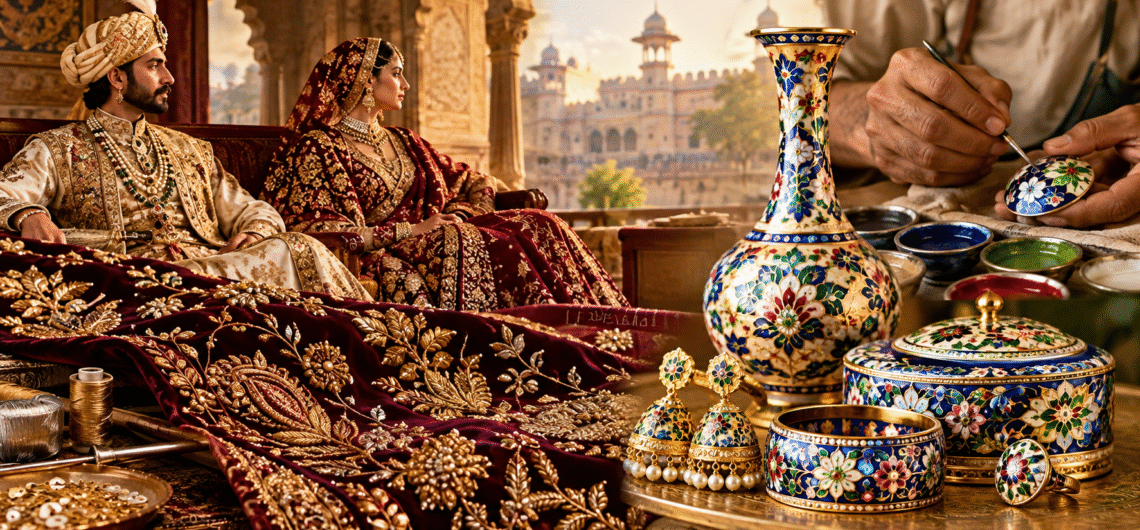
Agra is famous around the world for the Taj Mahal, but the city’s cultural heritage extends far beyond its magnificent monuments. For centuries, Agra has been associated with skilled artisans, traditional craftsmanship, and decorative arts that reflect the beauty of India’s history. Among these remarkable traditions are Zardozi embroidery and Meenakari, two crafts that showcase the creativity, patience, and technical expertise of Indian craftsmen. Also, Agra is worldwide famous for marble inlay work with semi-precious stones.
From luxurious garments decorated with metallic threads to intricate ornaments featuring colourful enamel work, these traditional arts represent a connection between India’s royal past and its living cultural identity. Understanding Zardozi and Meenakari offers visitors another way to appreciate Agra, its Mughal heritage, and the generations of artisans who have preserved these skills.
1. The Historical Background of Zardozi and Meenakari
When you are on the same day Taj Mahal tour or as per the other plan, you will have a chance to see the art and craft. Zardozi and Meenakari developed within India’s long tradition of luxury crafts, supported by royal courts, wealthy patrons, merchants, and skilled artisan communities. Both techniques became closely associated with decorative objects and fine craftsmanship during different periods of Indian history.
The word “Zardozi” comes from Persian roots: “zar,” meaning “gold,” and “dozi,” meaning “embroidery.” The name reflects the traditional use of metallic threads to create elaborate designs on fabric. Zardozi has historical connections with Persian embroidery traditions and flourished under royal patronage in India, particularly during the Mughal period.
When you are on a Golden Triangle Tour, in Jaipur you may also see this art. Meenakari is the art of decorating metal surfaces with coloured enamel. Artisans apply specially prepared enamel to gold, silver, copper, or other suitable metals and use controlled firing to create durable, colourful designs. The technique requires precision because the enamel must be applied and fired carefully to achieve the intended appearance.
Although both crafts have links to royal luxury, they involve different skills. Zardozi transforms fabric through embroidery, while Meenakari adds colour and decoration to metal objects.
2. Zardozi: The Art of Silver and Golden Threads
The art of silver and golden threads is at the heart of Zardozi embroidery. Traditional artisans use metallic threads, decorative wires, sequins, beads, and other embellishments to create rich patterns on fabrics such as velvet, silk, satin, and brocade.
Historically, genuine gold and silver threads were used in some luxury embroidery. Modern Zardozi may use metallic-coated threads and other more affordable materials, allowing artisans to create decorative designs at different price points.
The process begins with a design that is transferred onto the fabric. The cloth is then stretched over a frame to keep the surface firm. Depending on the technique, artisans stitch metallic elements into the fabric or attach decorative materials to create raised patterns.
Common designs include flowers, leaves, vines, paisleys, geometric shapes, and intricate borders. These patterns often reflect the natural world, traditional Indian motifs, and the decorative vocabulary associated with royal clothing.
Zardozi is valued for its texture and depth. The metallic elements catch the light, giving garments and accessories a rich appearance. A single detailed piece may require many hours or even days of careful work, depending on the complexity of the design.
Today, Zardozi is used on bridal lehengas, sherwanis, sarees, wedding accessories, handbags, footwear, cushion covers, and decorative textiles. It remains an important part of Indian wedding fashion and ceremonial clothing.
3. Zardozi, the Dying Art of Agra
Zardozi, the dying art of Agra, is a phrase that reflects concern about the future of traditional embroidery rather than a claim that the craft has disappeared. Zardozi continues to be practised, but its long-term survival depends on whether artisans can earn a sustainable living and pass their knowledge to younger generations.
Agra’s historic connection with the Mughal court helped create an environment in which fine decorative arts could flourish. Royal patronage encouraged specialised crafts, and the movement of artisans, traders, and ideas helped shape the region’s artistic culture.
Over time, Zardozi became part of the broader craft traditions associated with North India. Local embroidery workshops and family-based production systems helped preserve traditional methods, with skills often learned through observation and repeated practice.
However, traditional artisans face several challenges. Machine embroidery can produce decorative patterns more quickly and cheaply than detailed handwork. Customers may struggle to distinguish handmade embroidery from machine-made alternatives, while rising material costs and lengthy working hours can reduce artisans’ earnings.
Younger people may also choose other occupations if traditional embroidery does not provide a reliable income. When experienced craftspeople retire without teaching apprentices, specialised techniques and design knowledge can gradually be lost.
Supporting handmade Zardozi products, choosing work from responsible sellers, and learning about the people behind each piece can help preserve this heritage. Fair payment is especially important because the value of handmade embroidery lies not only in its appearance but also in the skill and time required to produce it.
4. The Clothes of Zardozi Used by the Mughals & Maharajas
The clothes of Zardozi used by the Mughals and Maharajas form an important part of the history of royal Indian textiles. Mughal rulers and members of the court were associated with luxurious clothing made from fine fabrics and decorated with embroidery, woven patterns, and precious materials.
Courtly garments included robes, formal coats, ceremonial clothing, turbans, and other elaborate textiles. Metallic embroidery was one of the techniques used to create visually rich designs suitable for royal occasions and displays of status.
Floral patterns were particularly important in Mughal decorative art. Flowers, curling vines, leaves, and symmetrical compositions appeared in textiles, architecture, manuscripts, and other objects associated with the court. These design traditions influenced the wider development of Indian decorative crafts.
Gold and silver embroidery helped give garments a distinguished appearance. Velvet and silk provided rich backgrounds for metallic details, while carefully placed motifs created contrast and visual depth.
Luxury textiles were not restricted to everyday clothing. Fine embroidered fabrics could also be used for ceremonial coverings, furnishings, accessories, and gifts exchanged among members of royal and aristocratic households.
It is important to recognise that Mughal clothing traditions included many techniques, not Zardozi alone. Brocade weaving, patterned silk, other embroidery styles, and embellished fabrics also contributed to courtly dress. The exact materials and designs varied according to period, region, occasion, and the wealth of the wearer.
Today, bridal designers and traditional textile makers continue to draw inspiration from Mughal-era aesthetics. Modern Zardozi wedding garments preserve the appeal of metallic embroidery while adapting historical motifs to contemporary fashion.
5. The Use of Precious and Semi-Precious Stones in Zardozi
The use of precious and semi-precious stones in Zardozi adds another dimension to the decoration of luxury textiles. In some elaborate garments and accessories, embroidery is combined with beads, crystals, decorative stones, sequins, pearls, and other embellishments.
Historically, high-value courtly textiles and ceremonial objects could feature precious materials, depending on the patron’s wealth and the purpose of the item. However, not every Zardozi garment contained gemstones, and stones are not an essential component of the technique.
Artisans may attach stones or stone-like embellishments using embroidery stitches, metal settings, or specialised decorative techniques. Their placement requires care because the embellishments must remain secure without damaging the fabric.
Bridal wear is a common modern application. Designers often combine metallic threadwork with stones and beads to create detailed borders, heavily decorated sleeves, ornate necklines, and elaborate motifs. The result can be particularly striking under wedding lighting.
The quality of such work depends on more than the materials used. Balanced design, secure attachment, neat stitching, and careful finishing are essential. Genuine gemstones, imitation stones, crystals, and glass embellishments can produce very different results, so buyers should ask sellers to clarify the materials used.
For travellers interested in Indian handicrafts, Zardozi offers an opportunity to explore how textile traditions combine artistry, materials, and cultural symbolism.
6. Meenakari: The Forgotten Skill of the Artisan
Meenakari, the forgotten skill of the artisan, describes a craft whose complexity can be overlooked when people focus only on the finished jewelry or decorative object. Meenakari remains practiced in India, although the visibility and economic security of individual artisan communities vary.
The technique involves decorating a metal surface with coloured enamel. Artisans prepare the object, create or define the design, apply enamel to selected areas, and fire the piece under controlled conditions. Depending on the method and object, several rounds of application and firing may be necessary.
The colours can include blue, green, red, white, and other shades. Traditional designs frequently feature flowers, birds, leaves, and geometric patterns. The contrast between colourful enamel and polished metal creates the distinctive appearance associated with Meenakari.
The craft is used on jewellery, pendants, earrings, bangles, decorative boxes, utensils, and other ornamental objects. Different regions of India have developed their own approaches, materials, and design traditions.
Meenakari is associated with royal and courtly craftsmanship, including traditions that developed through cultural exchange between Persian and Indian artistic practices. It is also important to distinguish Meenakari from Zardozi: one decorates metal with enamel, while the other decorates textiles with embroidery.
The skill requires patience, steady hands, an understanding of colour, and technical knowledge of how enamel behaves during firing. Errors in preparation or heating can affect the finish, making experience especially valuable.
7. The Challenges Faced by Traditional Meenakari Artisans
Traditional Meenakari artisans face many of the same economic pressures experienced by other handmade craft communities. Mass-produced decorative goods compete on price, while buyers may not always understand the difference between skilled enamel work and simpler imitation finishes.
The cost of materials, the time required for production, and access to reliable markets can also affect the viability of small workshops. Artisans who depend on intermediaries may receive only a limited share of the final selling price.
Another concern is the transfer of specialised knowledge. Meenakari involves practical techniques that are difficult to master through written instructions alone. Apprentices benefit from working closely with experienced craftspeople, observing the preparation process, and learning through repeated practice.
Preserving this skill requires more than describing it as a forgotten art. Artisan training, fair compensation, craft exhibitions, direct sales, and transparent product descriptions can help build a stronger future for traditional work.
Although Meenakari has important associations with India’s wider royal craft heritage, buyers should check where an item was actually made. A product sold in Agra is not necessarily manufactured there, and regional techniques should be credited accurately.
8. Zardozi and Meenakari: Two Crafts, One Cultural Heritage
Zardozi and Meenakari demonstrate different ways in which Indian artisans transform ordinary materials into objects of beauty.
Zardozi uses metallic threads, stitches, and decorative embellishments to enrich fabric. Meenakari uses coloured enamel to decorate metal. One depends primarily on textile and embroidery skills, while the other combines design, metalworking, enamel preparation, and controlled firing.
Both crafts have benefited historically from royal patronage and demand for luxury objects. Both also depend on specialised knowledge that develops through years of practice.
Their significance extends beyond appearance. Each handmade piece reflects decisions about design, materials, technique, and finishing. When these crafts are appreciated only as inexpensive souvenirs, the labour behind them can be overlooked.
For visitors exploring Agra, learning about traditional craftsmanship provides a broader understanding of the city’s cultural identity. The Taj Mahal represents the extraordinary achievements of Mughal architecture, while India’s textile and decorative arts reveal another side of the artistic world that flourished around royal courts and urban craft communities.
9. How Travellers Can Support India’s Traditional Artisans
Travellers can contribute to craft preservation by making informed purchasing decisions and showing interest in the people who create handmade products.
- Choose authentic handmade work: Ask whether a product is hand-embroidered, machine-made, or a combination of both.
- Learn about the materials: Check whether metallic threads contain real gold or silver, and whether decorative stones are natural, synthetic, or imitation.
- Ask about the maker: Responsible sellers may be able to explain the workshop, artisan community, production method, or region of origin.
- Pay a fair price: Detailed handmade work requires time, experience, and careful finishing.
- Share the story: Responsible travel writing and respectful photography can help more people appreciate traditional Indian craftsmanship.
These simple actions can encourage greater recognition of India’s craft traditions and the people who keep them alive.
Conclusion: Discover the Artisans Behind India’s Heritage
Agra’s cultural story is not limited to monuments and historic buildings. It also connects with the wider artistic traditions of India, including the metallic embroidery of Zardozi and the colourful enamel work of Meenakari.
From the art of silver and golden threads to the careful application of enamel, these crafts reveal the patience and creativity required to transform materials into intricate works of art. Their historical associations with royal clothing, decorative objects, and courtly tastes make them valuable subjects for anyone interested in India’s past.
For Tours on Demands, exploring these traditions offers travellers a richer way to understand India’s living heritage. By appreciating handmade work, learning about its makers, and supporting responsible craft businesses, visitors can help ensure that traditional skills continue to inspire future generations.
Explore Agra beyond the Taj Mahal with Tours on Demands and discover the stories, craftsmanship, and cultural traditions that make India unique. Visit https://www.toursondemands.in/ to learn more about experiences in Agra and destinations across India.

Comments