
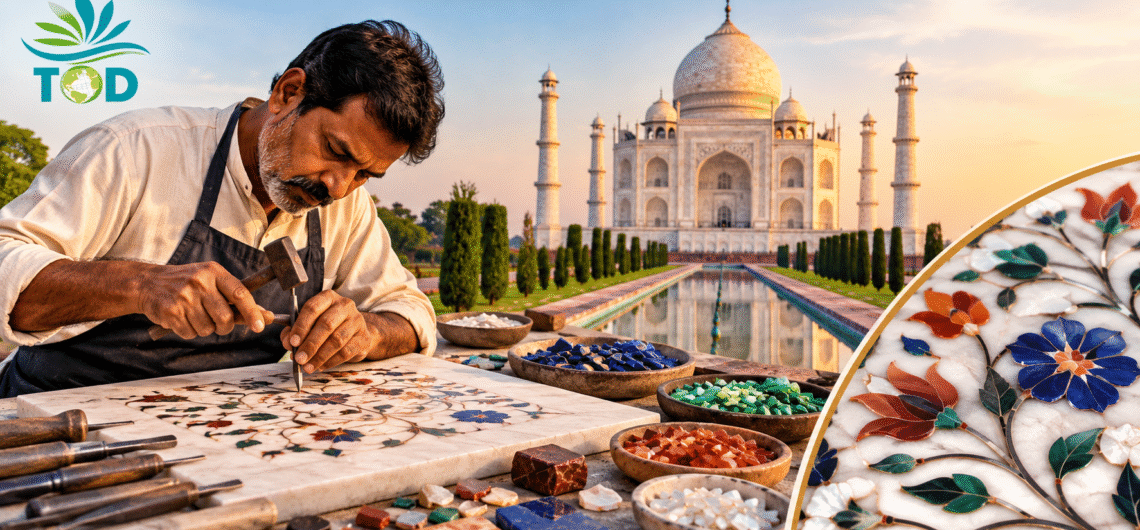
Agra is famous around the world for the Taj Mahal, but the city’s artistic heritage extends far beyond its magnificent white marble dome. Hidden within the monument’s delicate floral patterns is a centuries-old tradition of stone craftsmanship that continues to inspire visitors, artists, and historians. Known internationally as pietra dura and traditionally in India as pachhikari or parchin kari, this intricate art transforms ordinary marble into extraordinary works of beauty.
The marble inlay work at the Taj Mahal in Agra reflects the creativity, patience, and technical knowledge of generations of craftsmen. Using carefully shaped pieces of coloured stone, skilled artisans create flowers, leaves, vines, and geometric designs that appear to grow naturally from the marble surface.
For travellers visiting the Taj Mahal, understanding this traditional art adds another dimension to the experience. In this guide, Tours on Demands explores the history of pietra dura, the techniques behind the art work in Taj Mahal, and the artisans who continue to preserve Agra’s artistic legacy.
What Is Marble Inlay Work?
Marble inlay work is a decorative technique in which small pieces of coloured or semi-precious stone are cut and fitted into a carefully prepared surface of marble. The pieces form detailed designs, including floral motifs, leaves, vines, and decorative borders.
Unlike painting, which adds colour to a surface, this technique incorporates stone into the marble itself. When finished and polished, the different materials create a smooth, elegant design that appears almost like a natural part of the stone.
Agra is especially famous for this craft because of its association with Mughal architecture and the Taj Mahal. Local artisans continue to produce decorative tabletops, trays, jewellery boxes, coasters, and other handcrafted objects using traditional methods.
The quality of the finished piece depends on several factors, including the selection of stones, precision of cutting, accuracy of fitting, and final polishing.
History of Pietra Dura and the Taj Mahal
The story of pietra dura combines international artistic influences with the extraordinary achievements of Mughal-era craftsmen.
Pietra dura is an Italian term meaning “hard stone.” The technique became particularly prominent in Florence, Italy, during the Renaissance, where artists used carefully cut stones to create intricate decorative compositions.
During the Mughal period, decorative stone inlay developed into an important feature of Indian architecture. Under Emperor Shah Jahan, who commissioned the Taj Mahal in memory of his wife Mumtaz Mahal, the technique reached remarkable levels of sophistication.
Construction of the Taj Mahal began in the 17th century, and the main mausoleum was completed in 1648, with other parts of the complex finished later. Artisans from different regions contributed specialised skills, including stone cutting, marble carving, calligraphy, and decorative inlay.
The result was a monument in which architecture and craftsmanship work together. Its symmetrical design provides a grand setting for the delicate details of the marble surfaces.
Today, the Taj Mahal remains one of the finest places to appreciate the historic development of pietra dura and its enduring influence on Agra’s handicraft industry.
Art Work in Taj Mahal: Where to See the Finest Details
The Taj Mahal is admired for its proportions and white marble architecture, but its decorative details deserve equal attention.
1. Floral Patterns on Marble Surfaces
Flowers and plants are among the most recognisable motifs in the monument’s inlay work. Artisans used different coloured stones to represent petals, leaves, and stems with remarkable precision.
The designs are carefully balanced, creating a natural appearance while maintaining the symmetry associated with Mughal art.
2. Semi-Precious Stones Inlaid in Marble
One of the most fascinating features of the Taj Mahal is the use of coloured stones within white marble. Materials documented in descriptions of its decoration include jasper, carnelian, jade, lapis lazuli, and other ornamental stones.
Each material contributes a distinctive colour and texture. Red and orange stones can represent flower petals, green stones suggest foliage, and blue stones introduce contrast.
The semi-precious stones inlaid in marble are not simply decorative additions. Their shapes and colours are selected to work together as part of a larger artistic composition.
3. Decorative Panels and Borders
The marble surfaces feature detailed borders, flowing vines, and ornamental panels. These patterns frame architectural elements and complement the monument’s calligraphy and carved details.
Look closely at the floral designs when visiting the Taj Mahal. You will notice that their beauty comes from the combination of small individual pieces rather than a single painted image.
4. The Cenotaphs Inside the Main Mausoleum
The cenotaphs associated with Mumtaz Mahal and Shah Jahan display particularly refined decorative work. Their floral motifs and intricate inlays demonstrate the high level of skill achieved by Mughal lapidaries.
Visitors should follow monument rules and avoid touching the historic surfaces.
Art of Pachhi Kari: How Skilled Artisans Create Inlay Designs
The art of pachhi kari, also known as parchin kari, involves considerable planning and manual skill. Even a small decorative object can require many hours of careful work.
Although methods vary between workshops and projects, the process generally includes the following stages.
Step 1: Selecting the marble and stones
The artisan chooses a suitable marble base and coloured stones according to the intended design. Colour, hardness, thickness, and the natural appearance of each material influence the final result.
Step 2: Drawing the design
A floral pattern, leaf, border, or geometric composition is prepared. The design must be divided into individual shapes that can be cut from the selected stones.
Step 3: Cutting the marble surface
The outlines are transferred to the marble, and small recesses are created to receive the inlay pieces. This stage requires careful control because the stone can crack or chip if handled incorrectly.
Step 4: Shaping the stone pieces
The artisan cuts and shapes tiny fragments of coloured stone to match the individual spaces. Curved petals and narrow leaves are particularly challenging because even small inaccuracies can affect the overall design.
Step 5: Fitting the inlays
Each piece is fitted into its corresponding recess. The pieces must sit securely and align correctly with the surrounding design.
Step 6: Finishing and polishing
The surface is smoothed and polished until the inlay and marble form a refined finish. The completed design reveals the colours and details of the stones.
This process demonstrates why authentic marble inlay work depends on experience and patience rather than machinery alone.
Craftsmen and Craftsmanship: The People Behind the Art
The history of the Taj Mahal is often associated with Emperor Shah Jahan, but its artistic achievements were made possible by the craftsmen who designed, shaped, and assembled its many components.
Historical accounts describe a diverse workforce that included stonecutters, sculptors, lapidaries, calligraphers, masons, and other specialists. Their knowledge came from different regions and artistic traditions.
Over generations, Agra developed a lasting reputation for marble craftsmanship. Skills were passed from experienced artisans to younger members of their families and workshops. Today, traditional inlay work remains an important part of the city’s handicraft identity.
Modern artisans must balance tradition with the practical demands of contemporary production. Creating a small souvenir and producing a complex, high-quality marble panel require different levels of time and precision.
The best examples of this craft reveal the artisan’s understanding of colour, proportion, stone behaviour, and fine detailing.
Supporting genuine handmade work helps sustain these skills and gives visitors a deeper connection to Agra’s living cultural heritage.
Where Can You See Marble Inlay Work in Agra?
The Taj Mahal is the most famous place to appreciate historic pietra dura, but it is not the only monument in Agra associated with decorative stonework.
Itimad-ud-Daulah’s Tomb, often called the Baby Taj, is particularly worth visiting. Built between 1622 and 1628, it is an important earlier Mughal monument featuring extensive pietra dura decoration.
Agra’s traditional handicraft workshops and marble shops also offer opportunities to observe or purchase modern examples of the craft. If you wish to see a demonstration, ask whether artisans work on the premises and whether visitors are permitted to watch.
When purchasing an item, ask about the materials used, whether the piece is handmade, and how it was produced. Prices can vary depending on the size, stone quality, design complexity, and amount of labour involved.
Best Way to Explore Agra’s Marble Craft Heritage
A well-planned Agra visit can combine the Taj Mahal’s architectural beauty with the city’s wider artistic traditions.
Begin with the Taj Mahal to appreciate its original marble inlay and floral designs. Continue to Agra Fort to explore another important chapter of Mughal history. If time permits, visit Itimad-ud-Daulah’s Tomb to see another significant example of decorative stonework.
You can also include a visit to a reputable local workshop to learn about contemporary marble craftsmanship. Choose workshops that explain their techniques clearly and allow you to explore.
Tours on Demands can help you explore tour options for Agra and plan a visit around its famous monuments and cultural attractions.
Conclusion: Discover the Living Art of Agra
The marble inlay work of Agra is much more than a decorative feature of the Taj Mahal. It is a testament to the imagination, technical knowledge, and dedication of the artisans who helped create one of the world’s most admired monuments.
From the delicate floral patterns of pietra dura to the traditional art of pachhi kari practised by contemporary craftsmen, this heritage connects Mughal-era artistry with modern Indian handicrafts.
When you visit the Taj Mahal, take time to look beyond its grand dome and magnificent architecture. Observe the coloured stones, fine borders, and intricate floral details that reveal the extraordinary skill behind the marble.
Plan your visit with Tours on Demands and discover the architectural wonders, traditional crafts, and cultural heritage that make Agra a memorable destination.
Explore available tour packages at www.toursondemands.in and experience the artistic legacy of the Taj Mahal and Agra.

Comments