
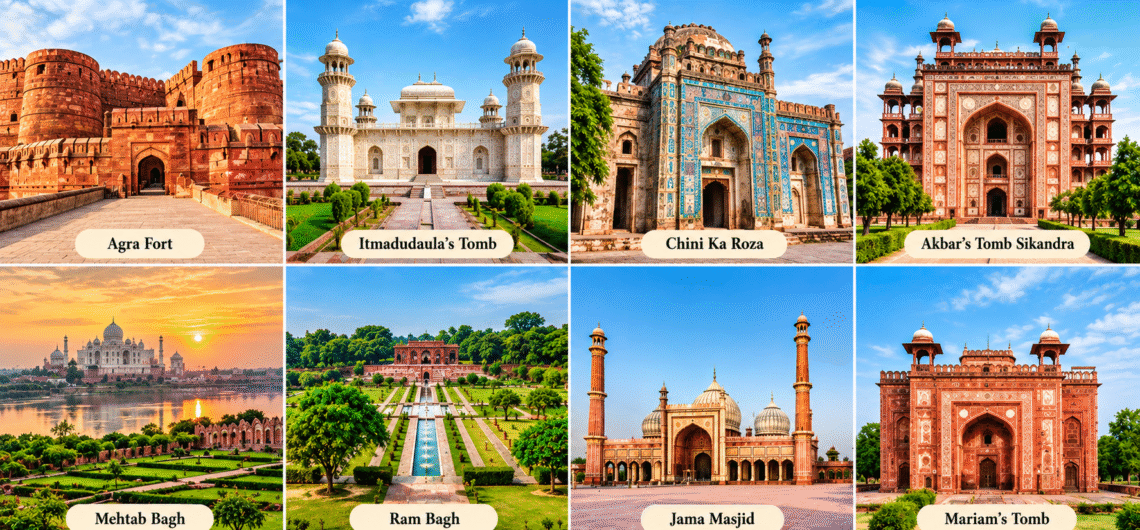
Agra is one of India’s most fascinating historical destinations, famous for its Mughal architecture, royal heritage, and beautiful monuments. While the Taj Mahal attracts millions of visitors from around the world, the city offers many other remarkable places that deserve a spot on every travel itinerary. From magnificent forts and elegant tombs to peaceful gardens and ancient architectural wonders, Agra has much more to explore beyond its most iconic landmark.
If you are planning an Agra sightseeing tour, discovering these historical monuments will help you understand the city’s rich past and appreciate the artistic achievements of the Mughal period. In this guide, Tours on Demands introduces some of the most famous monuments in Agra beyond the Taj Mahal.
1. Agra Fort: A Magnificent Mughal Fortress
Agra Fort is one of the most important historical monuments in India and a UNESCO World Heritage Site. Located near the Yamuna River, this impressive red sandstone fortress was developed extensively during the reign of Mughal Emperor Akbar in the 16th century.
The fort served as a royal residence, military stronghold, and administrative center of the Mughal Empire. Later emperors, including Shah Jahan, added elegant marble buildings and decorative features to its complex.
Visitors can explore beautiful structures such as Jahangir Palace, Diwan-i-Aam (Hall of Public Audience), Diwan-i-Khas (Hall of Private Audience), and the Musamman Burj. The fort also offers views towards the Taj Mahal from selected areas.
Why visit Agra Fort?
- Discover Mughal military architecture and royal history.
- Admire intricate stonework and impressive courtyards.
- Learn about the lives of Mughal emperors and their families.
- Enjoy views of the Yamuna River and the Taj Mahal.
Agra Fort is an essential stop for anyone interested in India’s history and architecture.
2. Itimad-ud-Daulah’s Tomb: The Baby Taj
Itimad-ud-Daulah’s Tomb is often called the Baby Taj because of its delicate marble design and decorative craftsmanship. Built during the reign of Emperor Jahangir, the tomb was commissioned by Empress Nur Jahan in memory of her father, Mirza Ghiyas Beg.
Completed in the 17th century, this monument is considered an important development in Mughal architecture. Unlike the red sandstone structures associated with earlier Mughal buildings, the tomb features extensive white marble, colourful stone inlay, carved screens, and Persian-inspired decorative elements.
The peaceful garden setting makes it an attractive destination for photography and a relaxing break from busier tourist areas.
What makes it special?
The tomb’s intricate pietra dura work, geometric patterns, and delicate marble lattice screens demonstrate the exceptional skills of the artisans of that period. These decorative traditions also help visitors appreciate the craftsmanship associated with later Mughal monuments.
For travellers who enjoy architecture, history, and photography, Itimad-ud-Daulah’s Tomb is one of the best places to visit in Agra beyond the Taj Mahal.
3. Akbar’s Tomb at Sikandra: A Royal Memorial
Akbar’s Tomb, situated in Sikandra on the outskirts of Agra, is the final resting place of Emperor Akbar, one of the most influential rulers of the Mughal Empire. Construction began during Akbar’s lifetime and was completed under his son, Emperor Jahangir.
The monument combines architectural influences from different traditions, creating a distinctive design. Its large gateway, red sandstone surfaces, marble detailing, and multi-story structure make it different from many other Mughal tombs.
The surrounding gardens add to the peaceful atmosphere, while the entrance gateway features impressive decorative work and intricate patterns.
Highlights of Akbar’s Tomb
- Explore a major monument associated with Mughal Emperor Akbar.
- Admire a blend of architectural styles.
- Walk through the landscaped garden complex.
- Photograph the monumental entrance and detailed ornamentation.
Akbar’s Tomb is particularly worthwhile for visitors who want to explore the history of the Mughal Empire beyond central Agra.
4. Chini Ka Rauza: A Hidden Architectural Gem
Chini Ka Rauza is a lesser-known historical monument located near the Yamuna River. It is the tomb of Afzal Khan, a Persian-origin scholar and statesman who served in the Mughal administration during the reign of Shah Jahan.
The monument is especially notable for its glazed tile decoration. The name “Chini” refers to the colourful glazed tiles that once decorated parts of the building. Although much of the original decoration has deteriorated over time, the structure remains an interesting example of Persian-influenced Mughal architecture.
Compared with Agra’s more famous attractions, Chini Ka Rauza generally receives less attention from tourists. This can make it appealing to travellers interested in exploring quieter historical sites.
A visit offers an opportunity to learn about the diverse artistic influences that shaped Mughal architecture and discover a different side of Agra’s heritage.
5. Mehtab Bagh: A Garden with a Taj Mahal View
Mehtab Bagh, meaning “Moonlight Garden,” is a historic garden complex situated across the Yamuna River from the Taj Mahal. Although it is not a monumental tomb or fort, it is an important heritage attraction connected with the Mughal landscape tradition.
The garden is associated with the carefully planned riverfront setting of the Taj Mahal. Its location provides a different perspective of the famous white marble mausoleum, particularly in suitable evening light.
Visitors can enjoy the open surroundings, photograph the Taj Mahal from across the river, and appreciate the relationship between Mughal gardens and architecture.
Why include Mehtab Bagh in your Agra itinerary?
It is ideal for travellers looking for scenic views, photography opportunities, and a quieter outdoor experience. The garden can also complement visits to Itimad-ud-Daulah’s Tomb and Agra Fort.
Check current entry arrangements and visiting hours before your visit, as conditions can change.
6. Mariam’s Tomb: A Monument with a Unique History
Mariam’s Tomb is another historical site near Sikandra. The monument is traditionally associated with Mariam-uz-Zamani, the Rajput wife of Emperor Akbar and the mother of Emperor Jahangir.
The building was originally constructed for another purpose and was later adapted into a tomb. Its architecture includes red sandstone, decorative panels, and features that reflect the artistic styles of its period.
Unlike the Taj Mahal, which is celebrated for its white marble symmetry, Mariam’s Tomb has a more understated appearance. Its historical associations make it a worthwhile stop for visitors interested in royal relationships and the cultural connections between Mughal and Rajput traditions.
If you are exploring Sikandra, consider checking whether Mariam’s Tomb can be included in your sightseeing route.
7. Jama Masjid: A Historic Mosque in the Heart of Agra
Agra’s Jama Masjid is a significant religious and historical landmark located near Agra Fort and the city’s busy old market area. It was built in the 17th century during the reign of Shah Jahan and is associated with his daughter, Jahanara Begum.
The mosque features a large courtyard, arched entrances, decorative stonework, and domes. Its architectural design reflects the religious and cultural life of Mughal-era Agra.
The surrounding streets provide a glimpse of the city’s traditional markets and everyday life. Visitors should remember that Jama Masjid remains a place of worship, so respectful clothing and behaviour are important.
For travellers interested in history, architecture, and local culture, the mosque offers a different experience from visiting royal tombs and palaces.
8. Ram Bagh: One of India’s Historic Mughal Gardens
Ram Bagh is among the oldest Mughal gardens in India and is traditionally associated with Emperor Babur, the founder of the Mughal Empire in India. The garden reflects the Persian-inspired charbagh concept, in which a landscaped area is divided into sections by pathways and water channels.
Although the garden has changed over time, it remains an interesting destination for visitors who want to understand how gardens formed an important part of Mughal design.
Unlike the grand architecture of Agra Fort, Ram Bagh focuses on landscaping, symmetry, and the relationship between nature and built spaces.
It is a good addition to an Agra heritage tour, especially for travellers interested in garden design, historical landscapes, and lesser-known attractions.
Best Time to Visit Agra’s Historical Monuments
The best time to explore Agra is generally from October to March, when daytime temperatures are often more comfortable for sightseeing. April to June can be very hot, so early-morning visits and adequate hydration are advisable. The monsoon season can bring humidity and rain.
Before travelling, confirm monument opening hours, weekly closures, ticket requirements, and photography rules through official or reliable sources. Some sites may have different arrangements or limited facilities.
Suggested One-Day Agra Sightseeing Itinerary
If you have one day to explore Agra beyond the Taj Mahal, consider this sample route:
- Morning: Visit Agra Fort and explore its royal palaces and courtyards.
- Late morning: Discover Itimad-ud-Daulah’s Tomb and its marble inlay work.
- Afternoon: Visit Chini Ka Rauza and Ram Bagh, depending on opening arrangements and travel time.
- Late afternoon: Explore Mehtab Bagh for views of the Taj Mahal across the Yamuna River.
- Alternative extension: If you have additional time, include Akbar’s Tomb at Sikandra and Mariam’s Tomb.
This itinerary is a suggestion rather than a fixed schedule. Actual timings will depend on traffic, opening hours, weather, and how long you wish to spend at each monument.
Explore Agra Beyond the Taj Mahal with Tours on Demands
Agra is much more than the Taj Mahal. Its forts, tombs, gardens, and historic mosques reveal the architectural achievements, cultural influences, and royal stories that shaped the city over several centuries.
From the grandeur of Agra Fort to the delicate marble craftsmanship of Itimad-ud-Daulah’s Tomb, each monument offers a different perspective on India’s heritage. Exploring these places can turn a short visit into a more meaningful cultural experience.
Tours on Demands helps travellers discover India’s historical destinations through sightseeing experiences and customised tour packages. Whether you are planning a same-day Agra trip from Delhi or a longer holiday covering India’s famous heritage cities, consider adding these remarkable monuments to your itinerary.
Visit www.toursondemands.in to explore tour options and plan your Agra sightseeing experience beyond the Taj Mahal.

Comments